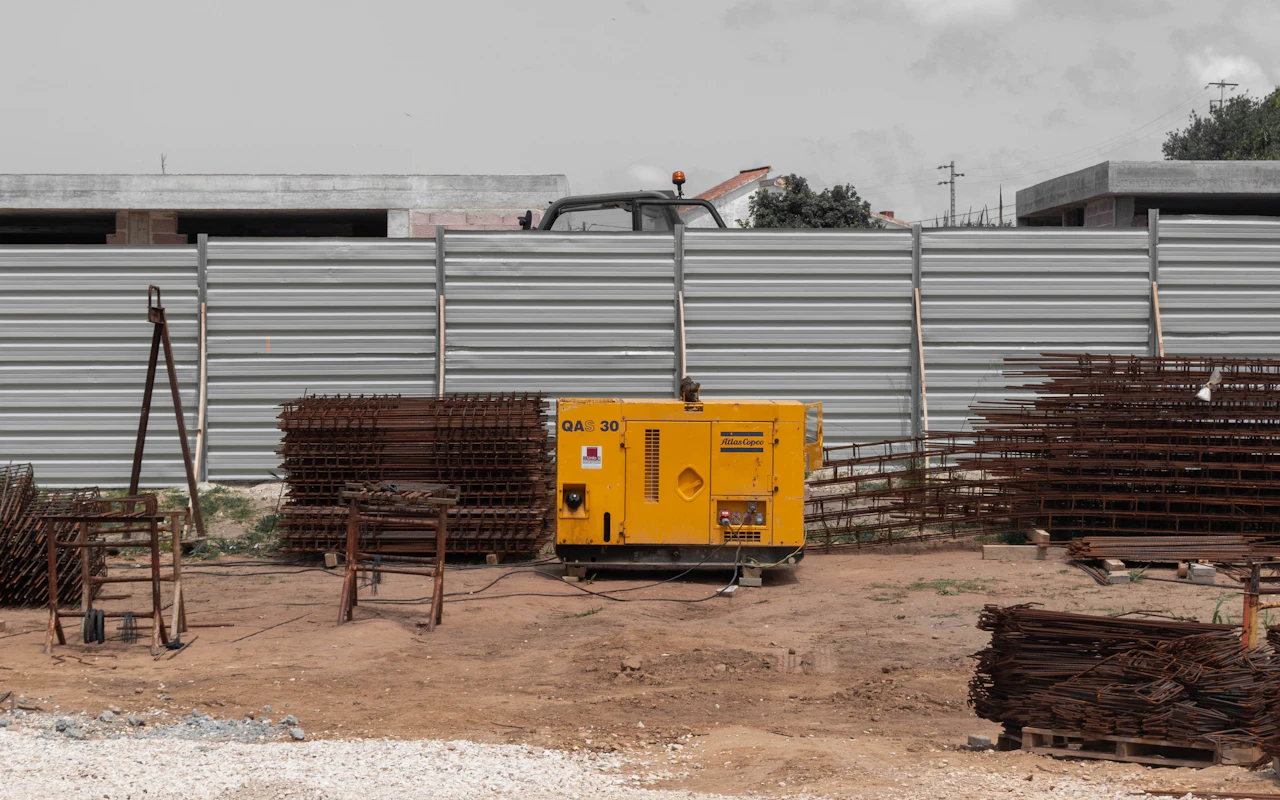
Generator Installation for Standby Power
A new standby set is a building services project rather than a delivery. Sizing, the changeover, the fuel store, the exhaust and the noise all have to be thought through before the set arrives.
This page covers commercial, public and farm sites. Engineers price installations after a site survey, because the groundwork and cabling vary more than the set itself.
- Wiring standard
- BS 7671, Section 551
- Running with mains
- Network operator involved (G99)
- Fuel store
- Usually a 110% bund (England)
Start with the load, not the set
Do you know what the set actually has to carry? The usual first step is a load survey: which circuits must stay on in a power cut, what they draw, and which motors start with a heavy kick.
From that, the engineer picks a size in kVA. Many sets are rated at a 0.8 power factor, so kVA and kW are not the same number. Our posts on what size generator a building needs and kVA to kW go into more detail.
The standards an installation works to
There is no single generator law, but several rules meet at the point where the set joins your building. Your engineer should be able to show how the design meets each one.
| Rule or standard | What it covers |
|---|---|
| BS 7671 | The wiring regulations. Section 551 covers low voltage generating sets, including standby sets. |
| Engineering Recommendation G99 | Sets that run in parallel with the mains, even briefly. The local network operator must be involved. |
| Oil Storage Regulations 2001 | In England, usually secondary containment such as a 110% bund for oil over 200 litres at a business, with some exemptions. |
| Electricity at Work Regulations 1989 | Covers the build and upkeep of the whole electrical system, set and panel included, so it does not cause danger. |
| Gas Safety Regulations 1998 | Gas-fuelled sets: gas work usually needs a Gas Safe registered engineer. |
Sets for events and other temporary supplies are planned to BS 7909 instead, which is a different kind of job.
The changeover is half the job
The set only helps if the building can be moved onto it safely. That is the job of the changeover: a manual switch, or an automatic transfer switch that senses the mains failing and starts the set.
It must also stop the set feeding back into the network, which would put people working on the lines at risk. Our changeover and ATS page explains the options.
Questions to settle on site
In a lot of cases the set is the easy part. These are the questions that tend to shape the cost and the timetable.
- Position: a plinth or hard standing, access for delivery and for future servicing.
- Noise: an acoustic canopy or enclosure, and distance from neighbours and windows.
- Exhaust: where it goes and how it clears the building.
- Fuel: a base tank or a separate bunded tank, and how it will be refilled.
- Cabling: the route from the set to the changeover and the main switchboard.
- Planning: whether your council needs to approve the enclosure or the flue.
Larger installations may also need an environmental permit under the specified generator rules.
How the job gets done
Describe the site
What the set must keep running, where it might go and any deadline.
Site visit
The installer walks the site, the switchroom and the likely route for cables and fuel.
Survey and design
A load survey, a position for the set and a changeover design.
Written quote
A price for supply, installation and commissioning, in writing.
Installation: questions
What size generator does my building need?
It comes from a load survey of the circuits that must stay on. Read our post on sizing a standby set for the method.
Can a standby generator feed back into the grid?
It must not unless that is designed for and agreed with the network operator. BS 7671 Section 551 covers the precautions, and sets that run in parallel with the mains come under Engineering Recommendation G99.
Do I need planning permission?
Sometimes, especially for a large enclosure, a flue or a set close to homes. Your installer or the local council can tell you for your site.
Does the fuel tank need a bund?
Usually, in England. In England, oil stored above ground at a business in a container over 200 litres usually needs secondary containment, such as a bund holding 110% of the tank. There are exemptions, for example some tanks inside a building that would hold a leak (Control of Pollution (Oil Storage) (England) Regulations 2001).
Do you fit generators for homes?
This site is for commercial, public and farm sites. If you need a set for a house, say so on the form and we will tell you plainly if we can help.
Sources for this page
- BS 7671 Requirements for Electrical Installations (IET)
- Electricity at Work Regulations 1989: regulation 4 text on legislation.gov.uk
- Energy Networks Association (Engineering Recommendation G99)
- Control of Pollution (Oil Storage) (England) Regulations 2001 (legislation.gov.uk)
- Gas Safety (Installation and Use) Regulations 1998 (legislation.gov.uk)
- BS 7909:2023+A1:2024 Temporary electrical systems for entertainment and related purposes (BSI)
- Specified generator: when you need a permit (GOV.UK)
Ask for a quote for your generator
We look for one service engineer who works in your area and tell you who they are before any of your details go to them. You pay nothing for this.
- You tell us where the set is and what it needs.
- We name an engineer who covers your site.
- You say yes or no before your details are passed on.
- They quote in writing, directly to you.
Thank you. Your request is with us.
We will be in touch by email or phone with the name of a service engineer who covers your site. Your details go to them only if you agree, and the price comes from them in writing. We send no marketing.