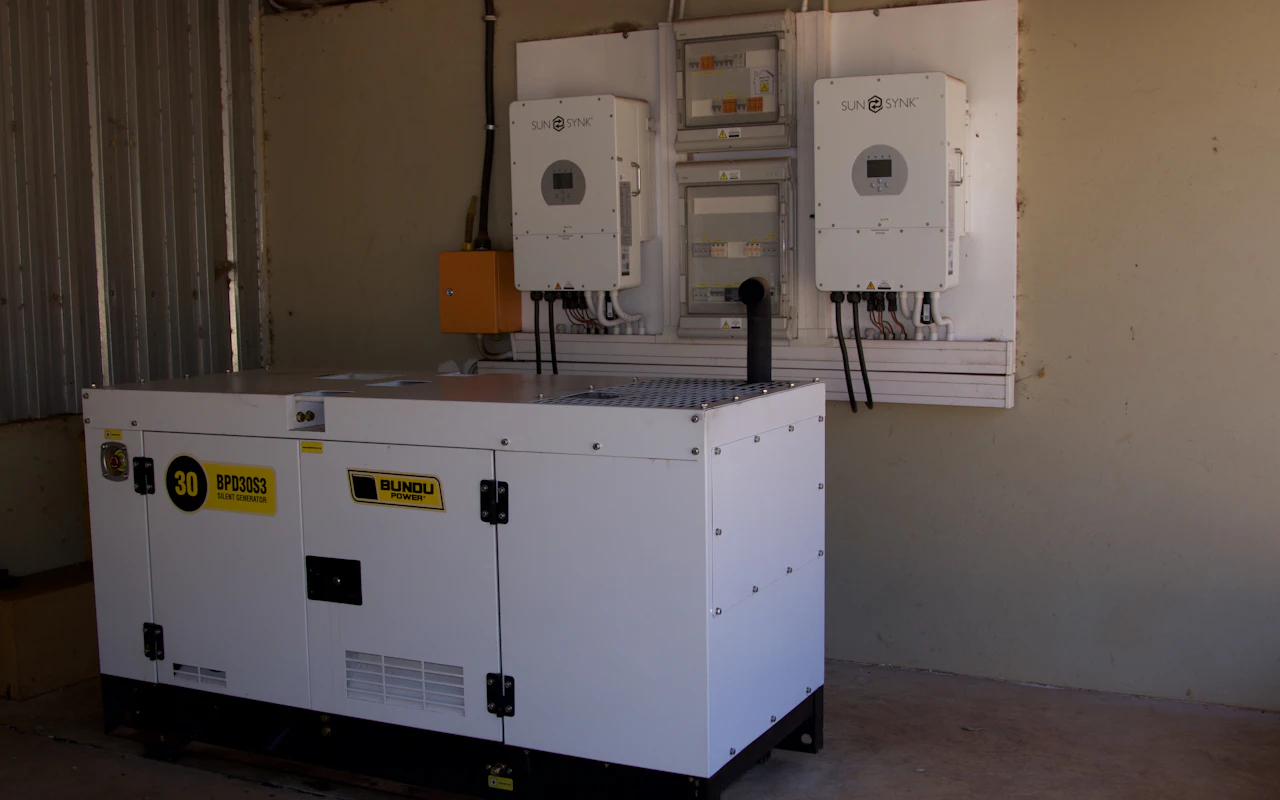
Load Bank Testing for Standby Generators
A load bank is a portable electrical load that lets a generator be worked hard without putting your building at risk. It is the closest thing to a real power cut you can arrange on purpose.
One public sector tender asked for a yearly four-hour test on every standby set, proving the engine up to 110% of full load. That is a sound starting point for your own plan.
- Tender pattern
- Once a year, four hours
- Load
- Up to 110% of full load
- Standard
- BS ISO 8528 (generating set ratings)
What a load bank test proves
Routine checks often run a standby set with nothing connected, or with only part of the building on it. That shows the engine starts. It does not show that it can carry its rated load for hours without overheating, losing voltage or shutting down.
A load bank closes that gap. The engineer connects it to the set, steps the load up in stages and records how the engine and alternator behave at each one. Because the load is artificial, the test can run while the building stays on the mains.
Why light running is a problem for diesel sets
If your set is only ever run for short, unloaded tests, you may find that it smokes heavily or leaks oily residue from the exhaust. Engineers call this wet stacking: fuel that is not fully burnt because the engine never gets hot enough.
A long run under real load is the usual answer. It is one of the reasons tenders put a load bank test in the yearly plan rather than leaving it to chance.
Planning the test on your site
The test needs space for the load bank, a safe cable route and a few hours with the set running. Think about these before the engineer arrives.
- Where the load bank goes: usually beside the set, on hard standing with room to work around it.
- Noise and exhaust: the set will run at full output for hours, so warn neighbours and staff.
- Fuel: make sure the tank holds enough for the full test plus a reserve for a real outage afterwards.
- Permits: some sites need a permit to work or an escort for contractors.
- The record: ask for readings at each load step, in writing, for your maintenance file.
You can ask for the test to follow the major service, so the engine is checked before it is worked hard.
Ratings and kVA
How hard a set should be pushed depends on its rating. The BS ISO 8528-1 standard defines generating set ratings, such as emergency standby and prime power, and the test is planned against the rating on your set’s plate.
Sets are usually rated in kVA. Many are rated at a power factor of 0.8, so a 100 kVA set gives about 80 kW of real power. Our post on converting kVA to kW walks through the sums.
Larger plant and environmental permits
Very large generators, or groups of them, can fall under the specified generator rules and may need an environmental permit. Sets kept only for emergencies and tested occasionally are treated differently from sets that run to earn money from the grid. The GOV.UK guidance sets out when a permit is needed; your engineer or environmental adviser can help if your plant is near that scale.
How the job gets done
Tell us about the set
Size in kVA, the number of sets and where they are on the site.
Equipment matched
The engineer sizes the load bank and cabling to the rating of your set.
Plan the day
They agree access, the load steps, fuel and timing with you.
Test and report
The set is run under load and you receive the readings in writing.
Load bank testing: questions
How long does a load bank test take?
It depends on the plan, but the public tender we refer to asked for four hours a year on each set, proving the engine up to 110% of full load (Contracts Finder). Allow extra time to connect and disconnect the load bank.
Will the building lose power during the test?
Not normally. The load bank provides the load, so the building can stay on the mains while the set is tested.
How often should a set be load tested?
Once a year is the pattern in the tender above. Sites with critical loads, such as hospitals and data rooms, may follow their own sector guidance and test more often.
What is wet stacking?
Unburnt fuel and oily residue that build up in the exhaust of a diesel set that only runs at light load. A long run under real load is the usual remedy.
Can the test be done out of hours?
Usually, yes, though the set runs at full output and is noisy. Say so on the form and the engineer will plan around it.
Ask for a quote for your generator
We look for one service engineer who works in your area and tell you who they are before any of your details go to them. You pay nothing for this.
- You tell us where the set is and what it needs.
- We name an engineer who covers your site.
- You say yes or no before your details are passed on.
- They quote in writing, directly to you.
Thank you. Your request is with us.
We will be in touch by email or phone with the name of a service engineer who covers your site. Your details go to them only if you agree, and the price comes from them in writing. We send no marketing.