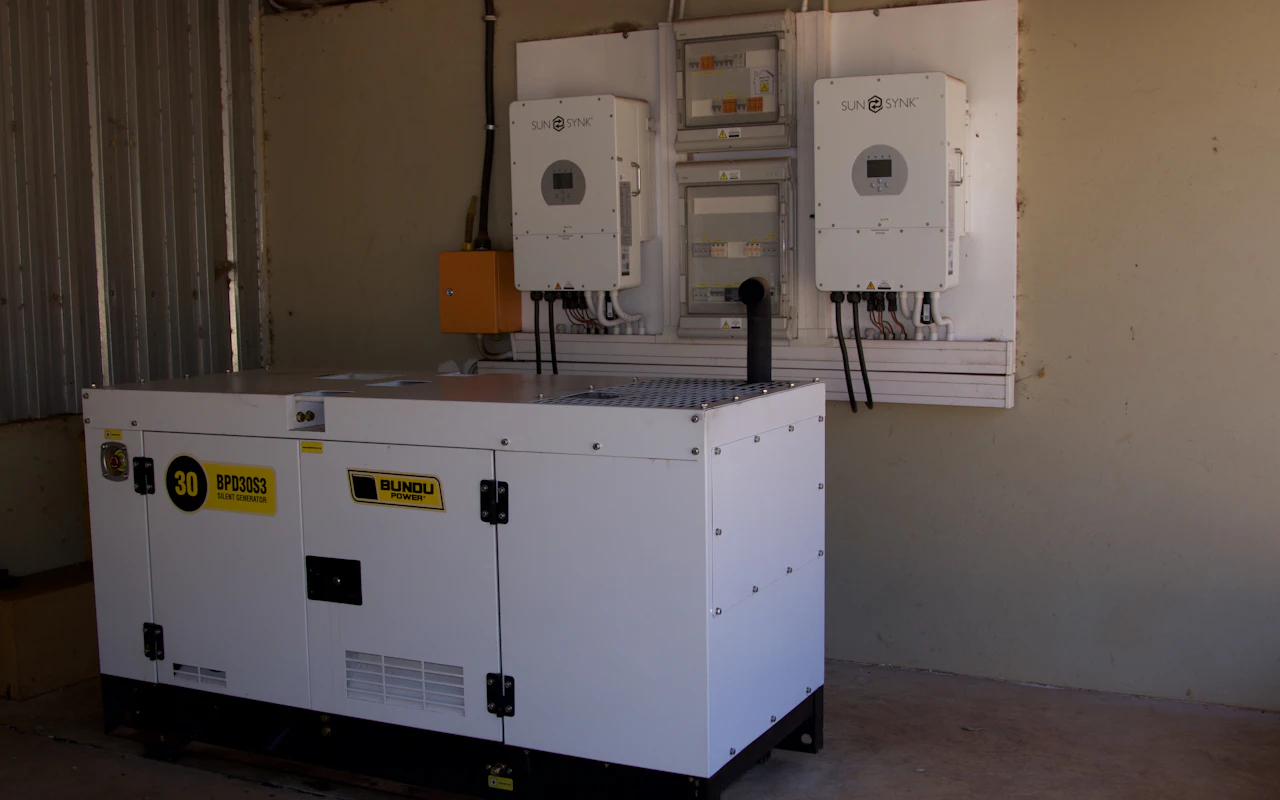
Generator Maintenance Contracts for Standby Sets
A standby set can sit quiet for months and then be asked to carry the building in seconds. Planned maintenance is how you find out it will, before the day it has to.
There is no national price list for this work. Engineers price each set after a survey, so the useful thing to know is what moves the figure: the size and number of sets, access, the state of the fuel and whether visits fall out of hours.
- Common minimum
- Two visits a year per set: one major, one minor
- Plus
- A yearly load bank test
- Legal basis
- Electricity at Work Regulations 1989, reg 4
Why a set that never runs still needs servicing
Most people assume an engine with low running hours is an engine in good order. With standby sets it tends to be the other way round. Batteries lose charge, fuel ages in the tank, hoses and belts perish with time rather than use, and a set that only ever runs for a few minutes off-load never gets properly hot.
There is also a legal side. Regulation 4 of the Electricity at Work Regulations 1989 says electrical systems must be maintained, as far as is reasonably practicable, so they do not cause danger. A standby set and its changeover panel are part of your system. The HSE’s guidance on the Regulations (HSR25) explains how that duty is read in practice.
What a service year usually looks like
Contracts vary, but a public sector tender for standby generator maintenance gives a fair picture of a sensible minimum (Contracts Finder, August 2021). It asked for two routine visits a year for each generator, one major and one minor, and a load bank test on every set once a year.
That load bank test was spelled out: four hours, proving the engine’s condition up to 110% of full load. In other words, the set is made to work harder than it would on a normal day, for long enough to show up anything that only fails when hot.
| Item | How often in that tender | What it is for |
|---|---|---|
| Major service | Once a year | The full planned service set out in the maker’s schedule for the engine and alternator |
| Minor service | Once a year | An interim check between major services |
| Load bank test | Once a year, four hours | Proves the engine up to 110% of full load |
Your own contract may sensibly go further. A hospital, a data room or a site with several sets may want more frequent visits, remote monitoring or cover outside working hours.
What to ask for in writing
It’s very important that the contract says exactly what each visit includes, because “service” means different things to different firms. Before you sign, ask the engineer to put these down on paper.
- A visit schedule for each set, with which visits are major and which are minor.
- The task list for each kind of visit, including which filters, fluids and batteries are replaced and when.
- Whether a load bank test is included, how long it runs and at what load.
- Fuel: whether a sample is taken and tested, and what happens if it fails.
- The changeover panel: whether the transfer switch is tested as part of the visit.
- Call-outs: how a breakdown between visits is handled and charged.
- The report you get after each visit, so your records show the work was done.
You may find two quotes that look far apart are simply covering different things. The written task list is what lets you compare them fairly.
What moves the price
Engineers in this trade price per set after seeing it, and you will rarely find a published rate. The figure is mostly driven by a handful of things you can describe up front.
- Size of each set, in kVA, because bigger engines take more oil, filters and time.
- Number of sets on the site, and whether they run together.
- Access: a set in a basement, on a roof or behind a secure line takes longer to reach.
- When the work can happen: out-of-hours visits cost more than daytime ones.
- The state of the fuel, if it needs cleaning before the set can be trusted.
Our scope builder turns these into a written scope you can send with your request, so every engineer quotes against the same brief.
Gas-fuelled and temporary sets
If your set runs on natural gas or LPG, work on the gas side usually needs a Gas Safe registered engineer, under the Gas Safety (Installation and Use) Regulations 1998. Make sure the firm you choose either holds that registration or brings in someone who does.
Sets brought in for events and other temporary supplies are a different job again. They are normally planned to BS 7909, the code of practice for temporary electrical systems for entertainment and related purposes.
How the job gets done
Send the details
Where the set is, its size, how many there are and when the last service was, if you know.
First conversation
The engineer asks about the set, the site and any history of faults or alarms.
Survey and scope
They look at the set, the panel and the fuel, then write down what each visit will include.
Written quote
You get a price for the year in writing and decide whether to go ahead.
Maintenance contracts: questions
How often should a standby generator be serviced?
One public tender set two visits a year per set as the minimum, one major and one minor, with a yearly load bank test (Contracts Finder). The engine maker’s schedule also sets service points by running hours.
Is servicing a legal requirement?
There is no law that names generator servicing as such, but the Electricity at Work Regulations 1989 require electrical systems to be maintained, so far as is reasonably practicable, to prevent danger. A planned service record is the plainest way to show you have done that.
What is the difference between a major and a minor service?
A major service is the full planned service from the maker’s schedule. A minor service is a lighter interim visit between majors. The exact task list varies by engine and firm, which is why you should ask for it in writing.
Does the contract need to include a load bank test?
It is worth asking for one. A set that only runs off-load during routine checks never shows how it copes with real work. The tender pattern above asks for a four-hour test up to 110% of full load each year. Our load bank testing page explains more.
Can one contract cover several sites?
Yes, and it often makes sense for a group of care homes, surgeries or offices. Say so on the form and list the postcodes in the notes, and the engineer can price the sites together.
Why can’t you show prices?
Because nobody official publishes them, and the firms in this trade price each set after a survey. Rather than guess, we explain what moves the figure and let the engineer quote you properly.
Sources for this page
- Electricity at Work Regulations 1989: regulation 4 text on legislation.gov.uk
- HSR25: Memorandum of guidance on the Electricity at Work Regulations 1989 (HSE)
- Standby generator maintenance tender notice, 13 August 2021 (Contracts Finder, GOV.UK)
- Gas Safety (Installation and Use) Regulations 1998 (legislation.gov.uk)
- Gas Safe Register
- BS 7909:2023+A1:2024 Temporary electrical systems for entertainment and related purposes (BSI)
Ask for a quote for your generator
We look for one service engineer who works in your area and tell you who they are before any of your details go to them. You pay nothing for this.
- You tell us where the set is and what it needs.
- We name an engineer who covers your site.
- You say yes or no before your details are passed on.
- They quote in writing, directly to you.
Thank you. Your request is with us.
We will be in touch by email or phone with the name of a service engineer who covers your site. Your details go to them only if you agree, and the price comes from them in writing. We send no marketing.